Partner Harrison Post
Queer Places:
University of Virginia, Charlottesville, VA, United States
William Andrews Clark Memorial Library, 2520 Cimarron St, Los Angeles, CA 90018
Hollywood Forever, 6000 Santa Monica Blvd, Los Angeles, CA 90038, United States
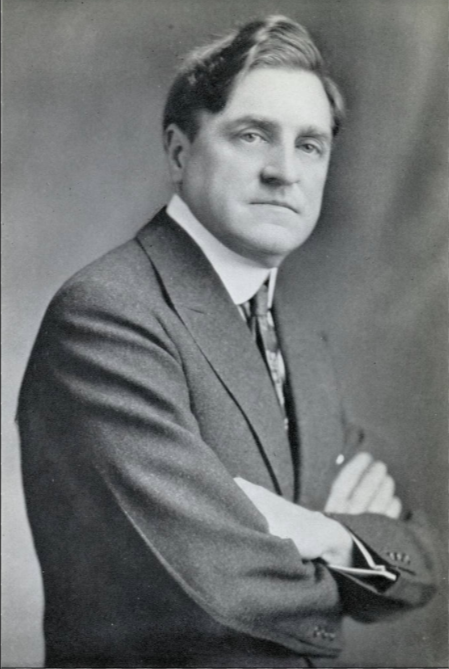 William Andrews Clark Jr. (March 29, 1877 - June 14, 1934) was born on March 29, 1877, in Deer Lodge, Montana, as the youngest surviving son of wealthy
copper mining magnate and future United States Senator William Andrews Clark and his wife, Katherine Louise Stauffer. Raised in immense wealth, Clark
received his early education in France and New York before earning a bachelor's degree in law from the University of Virginia in 1899. Returning to
Montana after graduation, he practiced law as a partner at the firm Clark & Roote in Butte while simultaneously sitting on the boards of his family's
vast industrial and mining enterprises. Over time, his interests shifted away from the corporate realm toward arts, music, and philanthropy, prompting
his move to Los Angeles in the early 1910s.
Clark’s adult life was marked by profound personal tragedy alongside his intense cultural pursuits. He married his first wife, Mabel Duffield Foster,
in 1901, but she died of post-partum sepsis in 1903 following the birth of their son, William Andrews "Tertius" Clark III. Clark married his second wife,
Alice McManus, in 1907, but she also passed away prematurely in 1918. Tragedies culminated in 1932 when his only child, Tertius, died in an Arizona
airplane crash.
Despite these personal losses, Clark emerged as one of Southern California's most influential cultural patrons. An accomplished amateur violinist, he
founded the Los Angeles Philharmonic in 1919, personally funding its operations for fifteen years to establish a world-class orchestra in the city. He
was also a vital financial backer in the construction and early development of the Hollywood Bowl, and supported higher education by funding Clark Hall
at the University of Virginia as well as a memorial library at the University of Nevada, Reno, in honor of his second wife.
In the mid-1910s, Clark turned his attention to serious bibliomania, hiring bibliographer Robert E. Cowan in 1919 to assist with purchasing rare
antiquarian books and manuscripts. To house his growing repository, Clark commissioned architect Robert D. Farquhar to construct a fireproof library on
his West Adams estate in Los Angeles. Completed in 1926, this building became the permanent site for his magnificent collection, which he bequeathed to
the University of California, Los Angeles upon his death.
Crucial to both Clark's private life and his collecting legacy were his romantic relationships with men, most notably with
Harrison Post. Post served as Clark's long-term lover, business collaborator, and confidant. Clark placed Post
in charge of the interior decoration of his specialized library, and tradition holds that the faces of thirteen nude figures painted across the library’s
opulent ceiling were modeled after Post. Clark ensured Post lived comfortably in a mansion directly across the street from his own on Cimarron Street and
ultimately established a substantial trust fund for him.
Together with Post, who co-transcribed Clark's extensive holding of Oscar Wilde's letters to Lord
Alfred Douglas, Clark assembled one of the world's premier collections of Wildeana. A cornerstone of this
collection became Harper Pennington’s famous 1884 life-sized portrait of Oscar Wilde, titled The Wedding
Gift. The painting had originally hung above the fireplace in Wilde’s London home on Tite Street, serving as a prized possession that scholars believe
may have subconsciously inspired Wilde's novel The Picture of Dorian Gray. Following Wilde’s infamous 1895 libel trial, conviction for gross indecency,
and subsequent bankruptcy, his household assets were auctioned off. The portrait was sheltered by loyal friends Ernest and Ada Leverson while Wilde faced
ruin. Decades later, Clark acquired the iconic canvas through Post, anchoring the library's status as a preeminent international archive for queer
history and literature. The portrait eventually traveled back to the UK in 2017 to feature in Tate Britain's landmark Queer British Art 1861–1967
exhibition.
William Andrews Clark Jr. died of a heart attack on June 14, 1934, at Salmon Lake in Missoula County, Montana, at the age of 57. He was interred
alongside his wives and son inside the grand Clark Family Mausoleum, which he had commissioned on an island at Sylvan Lake within Hollywood Forever
Cemetery in Los Angeles. His legacy lives on through the Los Angeles Philharmonic and UCLA's William Andrews Clark Memorial Library, which remains a
landmark destination for literary researchers and scholars of LGBTQ+ history.
References:
- Brown, Liz. Twilight Man: Love and Ruin in the Shadows of Hollywood and the Clark Empire (Penguin Books, 2021). A non-fiction investigation focusing extensively on Harrison Post, his relationship with Clark, the construction of the Clark Library, and Post’s legacy.
- Dedmond, Francis B. William Andrews Clark, Jr., His Cultural and Philanthropic Legacy (1988). A comprehensive overview detailing Clark’s life, arts patrons, law practice, and contributions to Southern California.
- Tate Britain. Queer British Art 1861–1967 Exhibition Catalogue (Tate Publishing, 2017). Details the provenance of Harper Pennington’s portrait of Oscar Wilde (The Wedding Gift), its passage through Ernest and Ada Leverson, Harrison Post, and Clark, as well as its place in international LGBTQ+ history.
- William Andrews Clark Memorial Library Archives (UCLA): Records of William Andrews Clark Jr. and the William Andrews Clark Memorial Library (Pre-1934), Online Archive of California (OAC). Contains original correspondence, invoices, family photographs, press clippings, cataloging records, and building plans for the West Adams property.
- University of California, Los Angeles (UCLA) Special Collections: Holds institutional records concerning Clark’s bequest, his relationship with bibliographer Robert E. Cowan, and the acquisition records for the Oscar Wilde collection.
- Los Angeles Philharmonic Archives: Institutional papers detailing Clark’s role as founder, sole financial supporter, and patron from 1919 until his death in 1934.
- The Los Angeles Times & The New York Times Archives: Contemporary reporting on Clark’s funding of the LA Phil and Hollywood Bowl, the tragic deaths of his wives and son, and front-page coverage of his death and estate on June 15–16, 1934.
- The Montana Standard & Butte Miner: Archival coverage of Clark’s early legal work at Clark & Roote, his copper interests, and news reports regarding his death at Salmon Lake.
- Cowan, Robert E., and John Henry Nash. The Library of William Andrews Clark, Jr. (Multi-volume series printed between 1920 and 1930). The printed catalogues commissioned by Clark to document his rare holdings, including early English literature and Wildeana.
- Powell, Lawrence Clark. The Clark Library: Dedication and Personal Recollections (UCLA Press). Writings by the former head librarian detailing Clark's legacy as a collector and the transfer of his estate to UCLA.
Support this project
This website is a passion project researched, developed, and funded entirely by me. If you find the content valuable and would like to help support the ongoing research and hosting costs, any contribution is deeply appreciated.
Thank you for keeping this independent resource alive!
My books on Amazon: Elisa Rolle's books
BACK TO HOME PAGE